
Wild Logic Ranch Lessons: One Hoofprint Is Not the Whole Herd
A clue can matter without becoming the entire story.
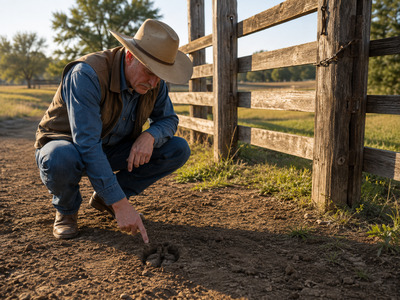
If you find one hoofprint beside the fence, you do not immediately announce that forty-seven cattle escaped, joined a traveling circus, and changed their names.
You look around.
That is ranch logic.
And emotional logic could use a little more of it.
A clue is useful. A verdict is something else.
Something happens and your system reacts.
That reaction matters.
But one reaction does not necessarily explain itself.
Maybe someone interrupted you and irritation shot through the roof.
Maybe a message went unanswered and anxiety arrived.
Maybe criticism felt much bigger than the actual words.
Maybe you woke up tired and every minor inconvenience suddenly appeared to have been personally designed by your enemies.
These moments are clues.
The trouble begins when a clue becomes a total conclusion.
"I reacted badly today" becomes "This is just who I am."
"That comment bothered me" becomes "Nobody respects me."
"I'm worried about this" becomes "Something terrible is definitely happening."
One hoofprint.
Whole herd declared missing.
What repeats is usually more useful than what surprises you once
Inside my trigger work, I emphasize pattern recognition because emotional reactions can otherwise feel random.
A person may think:
"I don't know. Sometimes I just get angry."
Or:
"Some days everything gets to me."
But when recurring situations become visible, what looked like chaos can start looking more like information.
Perhaps criticism repeatedly produces the strongest response.
Or being ignored.
Or feeling controlled.
Or disappointing someone.
Or believing you have failed.
Now you are no longer dealing with one mysterious bad day.
You are seeing terrain.
That matters because recurring emotional patterns tell you much more than a single incident ever could.
Your system can be spooked from several directions
Triggers do not all come from the same place.
Some come from external situations.
Some occur in relationships.
Some begin internally through thoughts, memories, expectations, or imagined conversations.
And some reactions become stronger because of your physical state - fatigue, hunger, illness, pain, overstimulation, or prolonged stress.
This last category deserves more respect than it usually gets.
A tired ranch horse may respond differently to a sudden sound than a rested one.
Humans are not exempt from having bodies.
Sometimes the problem did not grow overnight.
Your available resilience simply shrank.
That is useful information before you declare anything about your character, relationship, job, or future.
Random bad days make terrible managers
When emotional reactions are unexplained, people often turn them into identity judgments.
"Why am I like this?"
"Why can't I handle anything?"
"What is wrong with me?"
Those questions sound serious, but they often provide lousy data.
A better understanding begins when the reaction becomes observable.
Not good.
Not bad.
Observable.
That is one reason I approach emotional patterns analytically.
If the same thing keeps happening, there is something worth understanding.
That does not mean blaming yourself.
It does not mean blaming everyone around you.
It means noticing that the system has a pattern.
Patterns deserve attention, not prosecution
This distinction is important.
Awareness is not a courtroom.
You are not gathering evidence so you can convict yourself.
You are gathering information so that a reaction that once felt mysterious can become understandable.
There is dignity in that.
The moment you can say:
"This situation tends to hit me harder."
or:
"My mind often tells the same story when this happens."
you have already moved from vague emotional chaos toward clarity.
And clarity changes what becomes possible later.
You cannot work intelligently with a pattern you refuse to see.
But you also do not need to turn every difficult moment into a character indictment.
Facts first. Story second.
There is good ranch wisdom in inspecting the ground before announcing what happened to the herd.
What do you actually know?
What are you assuming?
Is this a one-time event?
Or have you seen this emotional pattern before?
Is the present situation truly enormous?
Or did it touch a familiar sensitive place?
Those questions do not make a difficult experience unimportant.
They keep the experience from becoming larger than the available evidence.
One hoofprint deserves attention.
It simply does not deserve control of the entire ranch.
This is why mapping comes before changing
Inside Mastering Emotional Pain: Reclaim Your Power, trigger awareness is not treated as vague advice to "know yourself better."
The course organizes triggers into understandable patterns and helps students see how events, meanings, emotional responses, body signals, recurring themes, and reactions fit together before moving deeper into changing those patterns.
That order is intentional.
Understanding first.
Then more choice.
Because once the terrain becomes visible, you are no longer wandering around wondering why the same patch of ground keeps surprising you.
And that is one of the great benefits of structured clarity:
The clue stays a clue.
The pattern becomes visible.
And you get to remain the person running the ranch.
Explore more here:
→→→→→ https://www.logicaltoo.com/mep
◇ ◇ ◇ ◇ ◇ ◇ ◇ ◇ ◇ ◇ ◇ ◇ ◇ ◇ ◇ ◇ ◇ ◇ ◇ ◇ ◇
🌿 Marilyn Burnette 🌿
Personal Power Coach | Calm Control in Real Life
Creator of the Trigger-to-New-Response Method
◇ ◇ ◇ ◇ ◇ ◇ ◇ ◇ ◇ ◇ ◇ ◇ ◇ ◇ ◇ ◇ ◇ ◇ ◇ ◇ ◇
